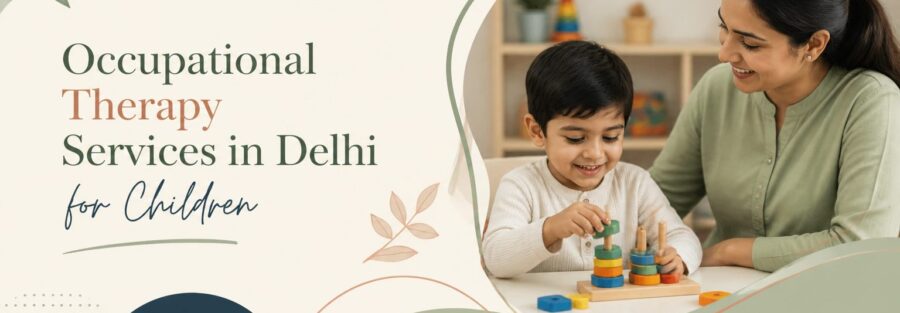
For parents in Delhi-NCR, watching a child struggle with everyday tasks — holding a spoon, sitting still in class, or reacting strongly to textures and sounds — can be deeply worrying. Many families search for “occupational therapy services” hoping to find answers, but the Indian therapy landscape is fragmented, jargon-heavy, and hard to navigate without insider knowledge. This guide explains exactly what occupational therapy is, who it helps, how a session works, what it costs in 2026, and how to verify a qualified therapist in Delhi so you can make confident decisions for your child.
TL;DR / Quick Answer
Occupational therapy services help children and adults build the physical, sensory, cognitive, and emotional skills needed for everyday independence. For children, OT most often supports autism, ADHD, sensory processing differences, developmental delays, cerebral palsy, and learning difficulties. A qualified OT holds a BOT or MOT degree and is registered with the All India Occupational Therapists’ Association (AIOTA). In Delhi, families can choose clinic-based, home-based, or tele-OT models depending on the child’s profile and family logistics.
Table of Contents
- What Are Occupational Therapy Services?
- Types of Occupational Therapy Services in India
- Who Needs Occupational Therapy? (Conditions Treated)
- How an Occupational Therapy Session Works
- Cost of Occupational Therapy Services in India
- How to Verify OT Credentials in India (AIOTA & RCI)
- Choosing the Right OT Setting: Clinic, Home, or Tele-therapy
- Occupational Therapy vs. Physiotherapy, Speech & ABA Therapy
- Top Cities for Occupational Therapy Services in India
- Frequently Asked Questions
What Are Occupational Therapy Services?
Occupational therapy services are healthcare interventions that help children and adults perform the everyday activities — known clinically as “occupations” — that make up daily life. For a child, those occupations include playing, dressing, writing, eating, regulating emotions, and participating in school. For an adult recovering from a stroke, occupations might mean getting dressed, cooking, or returning to work. The discipline dates back to the early twentieth century and is now recognised by the World Federation of Occupational Therapists (WFOT), the All India Occupational Therapists’ Association (AIOTA), and the Rehabilitation Council of India (RCI).
In India, occupational therapy is delivered by practitioners who typically hold a Bachelor of Occupational Therapy (BOT) or Master of Occupational Therapy (MOT) degree from a university affiliated with a recognised institution such as the National Institute for Locomotor Disabilities (NILD), SVNIRTAR, or AYJNIHH. The therapist’s role is to assess how a child processes movement, sensation, attention, and emotion, then design play-based, evidence-based activities that build the missing skills. If you are evaluating OT4KIDS Pediatric Therapy Centre in Delhi, you will find that the occupational therapy services offered at OT4KIDS follow exactly this model: thorough assessment, individualised goals, transparent sessions, and measurable progress reviewed every few weeks.
Types of Occupational Therapy Services in India
Occupational therapy in India is broadly divided into five specialisations. Paediatric OT is the largest and most visible segment, addressing developmental delays, autism, ADHD, learning difficulties, cerebral palsy, and sensory processing differences. Neurological OT focuses on adults recovering from stroke, traumatic brain injury, Parkinson’s disease, or multiple sclerosis, helping them regain independence in self-care, mobility, and cognition. Geriatric OT supports older adults with fall prevention, dementia care, arthritis management, and age-related frailty through environmental modifications and adaptive strategies.
Hand and upper-limb rehabilitation is a fourth branch that addresses post-surgical recovery, fractures, repetitive-strain conditions, and custom splinting. Mental-health OT works alongside psychiatrists and psychologists to help individuals with anxiety, depression, schizophrenia, and post-traumatic stress develop daily routines, social participation, and vocational skills. Across these branches, sensory integration therapy has emerged as a major subspecialty — particularly in paediatric clinics such as Occupational Therapy at OT4KIDS — because sensory processing differences underlie many of the challenges parents notice in young children, from clothing sensitivity to extreme reactions to sound or movement. Choosing the right specialisation early dramatically improves outcomes and prevents families from bouncing between unrelated therapies.
Who Needs Occupational Therapy? (Conditions Treated)
A multi-site population study across five Indian regions, published in PLOS Medicine, found that 9.2% of children aged 2–6 and 13.6% of children aged 6–9 had at least one neurodevelopmental disorder, and nearly one-fifth of those had more than one. These figures explain why Delhi paediatric clinics are seeing a steady rise in referrals. The most common conditions that benefit from OT include autism spectrum differences, ADHD, sensory processing disorder, global developmental delay, cerebral palsy, Down syndrome, learning disabilities, dyspraxia, handwriting difficulties, and feeding challenges.
For adults, the dominant OT caseload includes stroke rehabilitation, post-surgical hand therapy, Parkinson’s disease, traumatic brain injury, and age-related functional decline. Children struggling with picky eating, food aversions, or extreme texture sensitivity can benefit from specialised Sensory Feeding therapy, which uses graduated food exposure and oral-motor techniques. Children who are sensory-seeking or sensory-avoidant respond well to Sensory Integration therapy at OT4KIDS, which follows the Ayres Sensory Integration® framework. Importantly, OT does not claim to cure these conditions; instead, it helps children develop the functional skills, regulation strategies, and confidence needed to participate more fully in school, home, and community life.
How an Occupational Therapy Session Works
A typical paediatric OT session follows a predictable five-stage process that mirrors the model demonstrated at AIOTA’s flagship “Chiraku” screening program at OTICON 2024, where 72 children were assessed using multidisciplinary teams. The first stage is detailed assessment, which includes standardised tools such as the Sensory Profile, Peabody Developmental Motor Scales, and Canadian Occupational Performance Measure (COPM). The therapist also gathers parent interviews and observes the child in structured play to understand strengths and gaps.
The second stage is goal-setting. Based on assessment findings, the therapist and parent together define three to five measurable goals — for example, “independently button a shirt” or “tolerate a noisy classroom for 30 minutes.” The third stage is intervention, delivered through play-based, evidence-based activities such as obstacle courses for motor planning, weighted vests for proprioceptive input, or handwriting games for fine-motor control. Parents are typically able to observe from a waiting area, which psychological assessment and support services complement with formal cognitive and behavioural testing where needed. The fourth stage is home-programme design, where parents learn specific activities to repeat between sessions. The fifth stage is re-evaluation, usually every three to six months, to confirm progress and adjust goals. Most families report visible improvements within three to four months of consistent attendance.
Cost of Occupational Therapy Services in India
The cost of occupational therapy services in India varies significantly by city, setting, therapist qualifications, and whether the session is individual or group-based. In 2026, metro cities such as Delhi, Mumbai, Bengaluru, and Chennai typically charge higher rates than tier-2 cities. Several factors drive the cost: the therapist’s degree and experience, the inclusion of a formal assessment component, the use of specialised equipment like suspension swings or sensory gyms, and whether the session is delivered in-clinic, at home, or via tele-therapy.
Families should expect to budget separately for an initial assessment, recurring therapy sessions, periodic re-assessments, and any recommended home equipment such as therapy balls, weighted lap pads, or chewy tubes. Government schemes such as the Assistance to Disabled Persons for Purchase/Fitting of Aids/Appliances (ADIP) scheme run by the Ministry of Social Justice, and the National Handicapped Finance and Development Corporation (NHFDC) loan schemes, can sometimes subsidise assistive devices recommended by an OT. Some health-insurance policies and corporate Employee State Insurance Corporation (ESIC) plans cover rehabilitation therapy under specific conditions, though coverage varies widely by insurer, policy type, and pre-authorisation requirements. Families are encouraged to request a detailed fee schedule, ask about package discounts for block bookings, and confirm what documentation will be provided for insurance reimbursement.
How to Verify OT Credentials in India (AIOTA & RCI)
Verifying a therapist’s credentials is one of the most important steps before beginning occupational therapy services. In India, qualified occupational therapists hold a Bachelor of Occupational Therapy (BOT) or Master of Occupational Therapy (MOT) from a university recognised by the University Grants Commission (UGC) and ideally affiliated with institutions such as NILD, AYJNIHH, or SVNIRTAR. The All India Occupational Therapists’ Association (AIOTA) maintains a national membership directory and is the primary professional body that governs continuing education, ethical practice, and conference standards in India.
The Rehabilitation Council of India (RCI) regulates several rehabilitation professions; however, occupational therapy regulation has historically been governed through AIOTA and state-level councils rather than exclusively through RCI. Parents should request the therapist’s degree certificates, AIOTA membership number, and any specialised certifications such as Ayres Sensory Integration® (ASI) certification, Hand Therapy certification, or Neurodevelopmental Treatment (NDT) credentials. When evaluating a centre, look at the broader team — including how the centre is led, how therapists are trained, and how transparent the centre is about progress. Reviewing information such as About OT4KIDS and our child-centered approach, the profiles of clinicians like Meet our expert therapists including Dr. Arpan Kumar, and recognition such as OT4KIDS awards and 11-year milestone recognition can help families assess credibility at a glance.
Choosing the Right OT Setting: Clinic, Home, or Tele-therapy
Delhi families today can choose between three primary OT delivery models, and the best choice depends on the child’s profile, family schedule, and budget. Clinic-based OT, offered at established centres, provides access to specialised equipment such as suspended swings, scooter boards, therapy balls, balance beams, and sensory gyms that most homes cannot accommodate. It also allows multidisciplinary coordination under one roof. Clinic-based care is ideal for children with significant sensory, motor, or behavioural needs who benefit from a structured environment.
Home-based OT brings the therapist into your living space, which is excellent for generalising skills into real-life routines such as mealtimes, bathing, or homework. It works well for children who are anxious in new environments, have transportation challenges, or need environmental modifications at home. Tele-OT, delivered via secure video platforms, has matured significantly since 2024 and is now used for parent coaching, home-programme review, school-visit consultations, and follow-up sessions where travel is difficult. A blended model — initial clinic assessment followed by alternating home and tele-OT sessions — is increasingly common. Whatever the setting, ensure the therapist provides written goals, home activities, and periodic progress reports so you can track your child’s growth over time.
Occupational Therapy vs. Physiotherapy, Speech & ABA Therapy
Understanding the boundaries between related therapies helps families build the right multidisciplinary team. Occupational therapy focuses on functional independence — the everyday tasks that occupy a child’s day: dressing, writing, playing, eating, and regulating behaviour. Physiotherapy focuses on gross motor function, strength, range of motion, gait, and posture, often after injury, surgery, or neurological events such as cerebral palsy or stroke. Speech and language therapy addresses communication, articulation, language comprehension, social communication, and feeding mechanics from a speech-motor perspective. Applied Behaviour Analysis (ABA) is a structured behavioural intervention that teaches specific skills and reduces challenging behaviours using reinforcement principles, often used alongside OT for children with autism.
The therapies overlap meaningfully. A child with autism may receive OT for sensory regulation and handwriting, speech therapy for communication, ABA for behavioural and social skills, and special education for academic support. The most effective centres coordinate these disciplines so that goals reinforce one another rather than contradict each other. For families exploring integrated care under one roof, reviewing combined offerings such as ABA Therapy at OT4KIDS, Speech Therapy services, and Special Education programs can clarify how an integrated team works in practice rather than in theory.
Top Cities for Occupational Therapy Services in India
India’s strongest OT hubs are concentrated in tier-1 metro cities with established medical infrastructure, training institutes, and paediatric specialty centres. Delhi-NCR stands out for its high concentration of multidisciplinary paediatric clinics, AIOTA-affiliated practitioners, and access to government hospitals such as AIIMS and Safdarjung Hospital for complex rehabilitation cases. Mumbai offers strong neurological and hand-therapy specialties through hospitals like KEM, Hinduja, and Nanavati, alongside private paediatric centres. Bengaluru is recognised for evidence-based autism and sensory-integration programmes, partly because of its strong IT-driven parent community and AYJNIHH’s southern regional influence. Chennai has a deep bench of therapists trained at the Madras Medical College and SRM, with notable paediatric and rehabilitation institutions. Kolkata and Hyderabad round out the top tier, with growing private-clinic ecosystems serving both paediatric and adult caseloads.
Within Delhi specifically, families often narrow down their choice between established south-Delhi clinics, west-Delhi multidisciplinary centres, hospital-based rehabilitation departments, and home-visit practices. The right choice depends on your child’s condition, your family’s schedule, and whether you value multidisciplinary integration or specialist depth. Reading verified parent testimonials and success stories from families with similar concerns is one of the most reliable ways to evaluate a centre before committing to a long-term therapy plan.
Frequently Asked Questions
What are occupational therapy services for children?
Occupational therapy services for children are structured interventions that help kids develop the motor, sensory, cognitive, and emotional skills needed for everyday activities such as dressing, writing, playing, and participating in school. Sessions are play-based and tailored to each child’s developmental profile.
At what age should a child start occupational therapy?
A child can begin occupational therapy as early as 18 months to 2 years if developmental delays, sensory differences, or motor challenges are observed. Earlier intervention is consistently associated with better functional outcomes, particularly for autism, cerebral palsy, and global developmental delay.
How long does an occupational therapy session last?
A typical paediatric OT session lasts between 45 minutes and one hour, including direct therapy, parent discussion, and home-programme updates. Initial assessments usually require 60–90 minutes.
How many OT sessions will my child need?
The number of sessions depends on the child’s condition, severity, and goals. Many families attend weekly or twice-weekly sessions for three to six months before re-evaluation, with ongoing therapy as needed for continued skill development.
Is occupational therapy covered by insurance in India?
Some health-insurance policies, corporate group plans, and ESIC schemes cover rehabilitation therapy under specific conditions. Coverage varies widely, so families should request documentation from their OT and confirm pre-authorisation requirements with their insurer.
How do I choose the best OT centre in Delhi?
Look for AIOTA-registered clinicians with relevant specialisations, transparent assessment and goal-setting processes, parent observation options, written progress reports, and ideally a multidisciplinary team. Visiting the centre, asking about the therapist’s training, and reading parent testimonials are practical ways to evaluate quality.
Can occupational therapy help a child with autism?
Occupational therapy supports children with autism by helping them develop sensory regulation, motor skills, self-care independence, and school-readiness skills. OT does not claim to cure autism but meaningfully supports functional participation in daily life.
Conclusion
Occupational therapy services in India have matured into a regulated, evidence-based discipline with qualified practitioners in every major metro. For Delhi families, the combination of AIOTA-registered therapists, multidisciplinary centres, and growing government recognition means earlier access to high-quality care than ever before. If your child is showing signs of developmental delay, sensory differences, or motor challenges, the most valuable next step is a formal OT assessment — because every child carries unique potential waiting to shine, and the right support at the right time can help that potential blossom. Ready to begin? Book an occupational therapy consultation in Delhi-NCR today and take the first step toward your child’s brighter, more independent future.