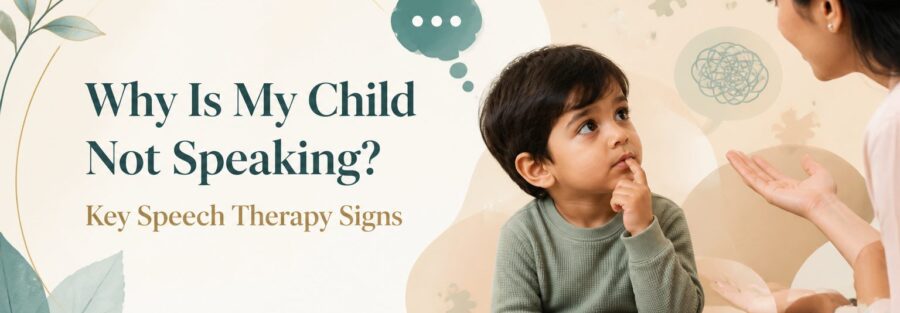
Introduction
Every parent eagerly waits for their child’s first words — “mama,” “papa,” or that adorable mispronounced request. When those words don’t arrive on time, worry quickly follows. If you have been searching “why is my child not speaking speech therapy signs,” you are not alone, and your concern is valid.
According to the National Institute on Deafness and Other Communication Disorders (NIDCD), approximately 7.2% of U.S. children ages 3–17 experience a voice, speech, or language disorder, with preschoolers being the most affected group. A 2023 JAMA Pediatrics study also reported a measurable post-pandemic rise in first-time speech delay diagnoses in children under five.
This guide breaks down the key speech therapy signs, age-wise milestones, common causes, and evidence-based interventions — with a special focus on Indian parents seeking the right support in 2026.
TL;DR / Quick Answer
If your child is not speaking yet, the most common reasons include hearing issues, oral-motor difficulties, developmental language delay, autism spectrum disorder, or being a “late talker.” Speech therapy signs to watch include no babbling by 9 months, fewer than 50 words by age 2, unclear speech after age 3, and limited social interaction. Early evaluation between 18–36 months offers the strongest outcomes, and professional speech-language therapy can dramatically improve communication when started during this critical window.
Table of Contents
- What Is Speech Therapy and Why It Matters
- Common Reasons Why Your Child Is Not Speaking
- Key Speech Therapy Signs and Red Flags by Age
- Age-Wise Speech and Language Milestones (Birth to 5 Years)
- Evidence-Based Speech Therapy Approaches That Work
- The Critical Role of Parents in Speech Development at Home
- When and How to Find a Speech Therapist in India
What Is Speech Therapy and Why It Matters for Non-Speaking Children
Speech therapy, formally called Speech-Language Therapy or Speech-Language Pathology, is a clinical specialty focused on evaluating and treating communication disorders. A trained Speech-Language Pathologist (SLP) — sometimes called a speech therapist — works with children who struggle with speech sound production, language comprehension, expressive vocabulary, social communication, voice, fluency (stuttering), and feeding or swallowing difficulties. For a non-speaking or minimally speaking child, therapy addresses the underlying reason behind the silence and builds a reliable path toward communication.
Why does speech therapy matter so much? Because communication is the foundation of learning, behavior, and social connection. Children who cannot express themselves often develop frustration, behavioral challenges, and academic delays that compound over time. According to the American Speech-Language-Hearing Association (ASHA), the brain is most plastic between birth and age 3, meaning early intervention during this window produces the strongest gains. Research consistently shows that children who begin speech therapy before age 3 make significantly faster progress than those who start later.
At OT4KIDS therapy services in Delhi-NCR, the team integrates speech therapy with occupational therapy and ABA therapy under one roof, allowing children with co-occurring motor, sensory, or behavioral needs to receive coordinated support. Their multidisciplinary approach has helped families across Hari Nagar and Chittranjan Park witness visible progress within 3–4 months of consistent therapy.
Common Reasons Why Your Child May Not Be Speaking Yet
Understanding the root cause is the first step toward meaningful intervention. Speech delays typically fall into one of four categories: receptive-expressive language disorder, speech sound disorder, social communication disorder, or motor speech disorder (including childhood apraxia of speech and dysarthria). Each has different causes and requires different therapy approaches.
Some children simply fall on the late end of the normal developmental spectrum — sometimes called “late talkers.” Studies suggest about 70–80% of late talkers catch up by school age without intervention, but that leaves 20–30% who do not. Common contributing factors include hearing loss (even temporary from chronic ear infections), oral-motor weakness, intellectual disability, autism spectrum disorder, limited language stimulation at home, bilingual confusion (which is usually not a true delay), and birth complications such as prematurity or low birth weight. The 2023 JAMA Pediatrics time-series analysis confirmed a sharp post-pandemic rise in speech delays, likely linked to reduced social interaction during lockdowns and increased screen exposure during critical developmental years.
A professional evaluation rules out or confirms these causes. Parents often feel reassured simply by knowing whether their child is a typical late talker or someone who would benefit from targeted support. At Speech Therapy at OT4KIDS, every assessment begins with identifying these root causes through standardized tools and parent interviews before designing an individualized therapy plan.
Key Speech Therapy Signs and Red Flags by Age
Spotting the warning signs early can change a child’s developmental trajectory. ASHA’s early identification guidelines outline specific red flags that distinguish typical variation from a true speech-language disorder. These are not hard rules — every child develops at their own pace — but they serve as a reliable screening framework for parents and pediatricians.
The most important speech therapy signs include no babbling or cooing by 9 months, no first words by 15 months, no two-word combinations by 24 months, fewer than 50 words at age 2, limited eye contact, not responding to their name, not pointing or gesturing to communicate, and difficulty being understood by familiar caregivers after age 3. Children who lose previously acquired words or skills also warrant immediate evaluation, as this can indicate a neurological concern such as autism or Landau-Kleffner syndrome.
For Indian parents, cultural context matters. Many well-meaning relatives advise “boys talk late” or “he’ll grow out of it.” While occasionally true, this advice can delay critical intervention. If multiple red flags appear together — for example, no pointing AND no words AND no eye contact at 18 months — a speech-language evaluation is essential. About OT4KIDS Pediatric Therapy Centre, the team encourages parents to trust their instincts rather than wait for problems to “fix themselves,” since early therapy during the brain’s peak plasticity window yields the strongest outcomes.
Age-Wise Speech and Language Milestones (Birth to 5 Years)
Milestones offer a useful map, but they describe averages — not absolutes. Below is a research-aligned summary of what most children achieve at each stage, adapted from ASHA and NIDCD developmental guidelines for 2026.
| Age Range | Expected Milestones |
|---|---|
| 0–12 months | Cooing, babbling, responding to name, first word around 12 months |
| 12–18 months | 10–50 words, follows simple directions, points to body parts |
| 18–24 months | 50+ words, two-word combinations (“more milk”), vocabulary explosion |
| 2–3 years | 200+ words, three-word sentences, understood by family 75% of the time |
| 3–4 years | Tells short stories, asks questions, understood by strangers 90% of the time |
| 4–5 years | Complex sentences, full conversations, clear pronunciation of most sounds except later-developing ones like “r,” “l,” and “th” |
If your child misses milestones by six months or more, or shows regression at any age, a professional speech-language evaluation is recommended. The American Academy of Pediatrics advises standardized autism and language screening at 18 and 24 months — a benchmark Indian pediatricians increasingly follow. Parents can track progress using free milestone checklists from ASHA or the CDC’s “Learn the Signs. Act Early.” program, available in multiple Indian languages.
Evidence-Based Speech Therapy Approaches That Work
Modern speech therapy is far more than “repeat after me.” Today’s SLPs use structured, evidence-based methods tailored to each child’s profile. Common approaches include the Hanen approach for parent-led early intervention, the Picture Exchange Communication System (PECS) for nonverbal children, Applied Behavior Analysis (ABA) integration for children with autism, the Lidcombe Program for stuttering, and oral-motor therapy for articulation disorders.
For children with autism or significant communication delays, augmentative and alternative communication (AAC) tools — including sign language, picture boards, and speech-generating tablets — can dramatically reduce frustration while supporting language development. Research consistently shows AAC does NOT delay natural speech; it often accelerates it.
The best therapy plans are individualized, play-based, and family-centered. Sessions typically run 30–45 minutes, one to three times per week, with parents trained to continue strategies at home. Visible progress is typically observed within 3–4 months of consistent therapy, though the exact timeline varies with the severity of the delay. For families seeking coordinated multidisciplinary support, the ABA Therapy program at OT4KIDS pairs behavioral and communication strategies effectively for children with autism.
The Critical Role of Parents in Speech Development at Home
Parents are a child’s first and most powerful language teachers. Research consistently shows that the quantity and quality of adult-child interaction in the first three years predicts language outcomes more strongly than any therapy session. This means what happens at the kitchen table, in the car, or during bath time matters more than parents often realize.
Practical parent-led strategies include narrating daily activities (“Mummy is putting rice in the bowl”), pausing during play to give your child a chance to communicate, following their lead instead of directing, expanding their single words into two-word phrases (“child says ‘ball,’ parent responds ‘big ball!'”), reading picture books daily with open-ended questions, and limiting screen time to under one hour of high-quality programming for ages 2–5, per the American Academy of Pediatrics. Singing nursery rhymes, especially in the child’s mother tongue, strengthens phonological awareness and pre-literacy skills.
If your child is nonverbal, resist the urge to speak for them or anticipate every need. Instead, create small frustrations — hand them a closed jar, put a desired toy out of reach — and wait, modeling simple words like “help,” “open,” or “want.” For children who understand more than they can express, visual supports like choice boards dramatically reduce communication breakdowns. Many Indian parents worry about exposing children to English too early, but research confirms bilingual exposure does not cause speech delays — only true disorders do. Speak in your strongest language; the goal is rich, meaningful input, not a specific tongue.
When and How to Find a Speech Therapist in India
Knowing when to seek help is just as important as knowing why. Schedule a speech-language evaluation if your child shows persistent red flags beyond the milestones discussed earlier, loses previously acquired words or skills, demonstrates no response to their name by 12 months, or struggles to be understood after age 3. Many Indian parents also seek evaluation upon preschool teacher recommendation — a valuable referral source.
In India, qualified speech therapists hold a Bachelor’s or Master’s degree in Audiology and Speech-Language Pathology (BASLP/MASLP) and are registered with the Rehabilitation Council of India (RCI). Reputable options include hospital-based departments (AIIMS, Apollo, Fortis), dedicated pediatric therapy centers, and tele-therapy platforms like Practo, Amaha, and HomeSpeechHome. Costs typically range from ₹500–₹1,500 per session depending on city and credentials, with assessment fees charged separately. Before booking, ask about the therapist’s specialization (some focus on fluency, others on autism or apraxia), session structure, parent involvement policy, and progress-tracking methods.
For families in Delhi-NCR, Book a consultation with OT4KIDS offers comprehensive speech-language assessments, individualized therapy plans, and parent coaching under one roof. Their multidisciplinary team integrates speech therapy with occupational and behavioral support — particularly valuable for children with complex needs. You can also contact our Delhi-NCR therapy team directly to discuss your child’s specific situation, request a personalized therapy plan, or schedule a visit to either the Hari Nagar or Chittranjan Park center. Tele-consultation options can be explored by calling +91 9999856433 or emailing the team.
Conclusion
When a child is not speaking, parents often oscillate between worry and hope — wondering whether to wait or act. The evidence is clear: early identification and intervention during the brain’s peak plasticity window (birth to age 3) produce the strongest outcomes, but meaningful progress is possible at any age with the right support.
Trust your instincts, track milestones, and seek a professional evaluation if red flags persist. Speech therapy is not a label — it is a gift of communication that opens doors to learning, friendships, and confidence for life.
If you are in Delhi-NCR and ready to take the next step, reach out to OT4KIDS today for a personalized consultation. Every small word is a big victory.
FAQs
What are the early speech therapy signs that indicate my child needs professional help?
Key speech therapy signs include no babbling by 9 months, no words by 15 months, fewer than 50 words or no two-word phrases by age 2, limited eye contact, not responding to name, and difficulty being understood after age 3. If multiple signs appear together or your child loses previously acquired skills, schedule a professional evaluation promptly.
At what age should I worry if my child is not speaking?
Most children say their first word by 12–15 months and combine two words by 18–24 months. If your child has no words by 18 months, no two-word combinations by 24 months, or unclear speech after age 3, consult a speech-language pathologist for evaluation.
Can a child outgrow a speech delay without therapy?
Approximately 70–80% of late talkers catch up on their own, but 20–30% do not — and waiting increases that risk. Early speech therapy accelerates progress, prevents secondary behavioral and academic challenges, and is most effective when started before age 3.
How long does speech therapy take to show results?
With consistent weekly sessions and active parent involvement at home, most children show visible improvement within 3–4 months. The exact timeline depends on the underlying cause, severity, therapy frequency, and family follow-through.
Does screen time cause speech delays?
Excessive passive screen time (over 1 hour daily for ages 2–5) is linked to language delays because it replaces interactive caregiver communication. However, screens are a contributing factor, not a sole cause — underlying disorders, hearing issues, or limited social interaction often play larger roles.
Is bilingual exposure responsible for my child’s speech delay?
No. Research confirms bilingual exposure does not cause speech delays. Children learning two languages may temporarily mix grammar rules, but they typically meet milestones in each language on schedule. True delays occur regardless of language count.
What happens during a speech therapy evaluation?
A speech-language pathologist conducts standardized assessments, observes your child’s communication attempts, reviews developmental history, and interviews parents about concerns. The evaluation identifies specific strengths and gaps, leading to an individualized therapy plan with measurable goals.
Can children with autism learn to speak?
Many children with autism develop functional speech, especially with early intervention. For those who remain minimally verbal, augmentative communication tools (PECS, sign language, speech-generating devices) provide reliable expression and often accelerate speech development rather than replace it.
Suggested Internal Links Used
| Anchor Text | URL | Section Used |
|---|---|---|
| OT4KIDS therapy services | http://www.ot4kids.in/services | What Is Speech Therapy and Why It Matters |
| Speech Therapy at OT4KIDS | http://www.ot4kids.in/services/speech-therapy | Common Reasons Why Your Child May Not Be Speaking Yet |
| About OT4KIDS Pediatric Therapy Centre | http://www.ot4kids.in/about | Key Speech Therapy Signs and Red Flags by Age |
| ABA Therapy | http://www.ot4kids.in/services/aba-therapy | Evidence-Based Speech Therapy Approaches That Work |
| Book a consultation with OT4KIDS | http://www.ot4kids.in/contact | When and How to Find a Speech Therapist in India |
| contact our Delhi-NCR therapy team | http://www.ot4kids.in/contact | When and How to Find a Speech Therapist in India |
| reach out to OT4KIDS today | http://www.ot4kids.in/contact | Conclusion |
Suggested External References
| Source Title | Publisher | URL | Reason Used |
|---|---|---|---|
| Quick Statistics About Voice, Speech, Language | NIDCD | https://www.nidcd.nih.gov/health/statistics/quick-statistics-voice-speech-language | Prevalence statistics for childhood speech disorders |
| Time-Series Analysis of First-Time Pediatric Speech Delays (2018–2022) | JAMA Pediatrics | https://jamanetwork.com/journals/jamapediatrics/fullarticle/2812152 | Post-pandemic rise in speech delay diagnoses |
| Early Identification of Speech, Language, Swallowing, and Hearing Disorders | ASHA | https://www.asha.org/public/early-identification-of-speech-language-and-hearing-disorders | Age-based red flag milestones |
| ASHA Announces New Developmental Milestones for Children Ages Birth to 5 | ASHA | https://www.asha.org/news/2023/asha-announces-new-developmental-milestones-for-children-ages-birth-to-5/ | Updated birth-to-five developmental benchmarks |
| Spoken Language Disorders Practice Portal | ASHA | https://www.asha.org/practice-portal/clinical-topics/spoken-language-disorders | Clinical reference for spoken language disorder categories |