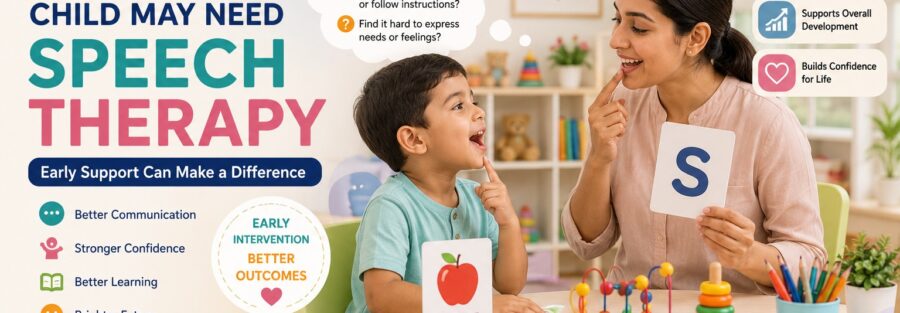
A complete parent-friendly guide to understanding speech delays, communication challenges, language development, and when to seek speech therapy support for children.
Introduction
As a parent, it is natural to notice every milestone in your child’s growth.
The first words.
The first sentences.
The excitement of hearing your child express emotions, needs, and thoughts.
But sometimes, concerns begin appearing.
You may start wondering:
- “Why is my child not speaking clearly?”
- “Is my child’s speech delayed?”
- “Should I consult a speech therapist?”
- “Will my child naturally catch up?”
The good news is this:
Every child develops differently.
However, when communication challenges begin affecting daily life, confidence, learning, or social interaction, early guidance can make a meaningful difference.
A child may benefit from speech therapy if they experience:
- Delayed speech development
- Difficulty speaking clearly
- Trouble understanding language
- Limited communication skills
- Social communication difficulties
- Developmental communication challenges related to autism, ADHD, or sensory needs
Early intervention often helps children improve:
- Communication
- Confidence
- Emotional expression
- Learning readiness
- Social interaction
- Daily functioning
Understanding the signs early helps parents provide better developmental support.
What Does a Speech Therapist Do for a Child?
A speech therapist helps children improve communication and language development.
Speech therapy is not only about pronouncing words correctly.
It may support:
- Speech clarity
- Language understanding
- Vocabulary development
- Communication confidence
- Listening skills
- Social interaction
- Expressive language
- Pronunciation
- Oral motor or feeding skills in some cases
The goal is to help children communicate more comfortably and confidently in everyday life.
Modern pediatric speech therapy uses:
- Child-friendly methods
- Evidence-based approaches
- Interactive learning
- Personalized intervention plans
Every child develops differently.
This is why therapy is usually tailored around each child’s unique strengths and developmental needs.
Signs Your Child May Need a Speech Therapist
Some communication differences are part of normal child development.
However, certain signs may indicate that additional support could help.
Here are some common signs parents should pay attention to.
1. Delayed Speech Milestones
One of the most common reasons parents seek speech therapy is delayed speech development.
Examples may include:
- Not speaking expected words for age
- Limited speech development
- Delayed sentence formation
- Difficulty expressing basic needs
- Reduced verbal communication
For example:
If a child struggles to communicate simple wants or language development feels significantly behind peers, evaluation may help identify whether support is needed.
Early support often creates stronger developmental outcomes.
2. Difficulty Pronouncing Words Clearly
Some children speak regularly but remain difficult to understand.
You may notice:
- Frequent mispronunciation
- Replacing sounds incorrectly
- Skipping sounds
- Unclear speech
- Difficulty forming certain words
Occasional pronunciation mistakes can be developmentally normal.
However, persistent speech clarity challenges may benefit from professional intervention.
Clear communication often improves:
- Confidence
- Social interaction
- Classroom participation
- Emotional expression
3. Limited Vocabulary or Communication
Some children speak very little or struggle expressing thoughts clearly.
Signs may include:
- Limited word usage
- Difficulty forming sentences
- Trouble expressing emotions
- Communication frustration
- Reduced conversational interaction
Children sometimes become emotionally frustrated when they cannot communicate effectively.
Speech therapy may help strengthen expressive language skills while improving emotional confidence.
4. Trouble Understanding Instructions
Communication involves more than speaking.
Some children struggle with language understanding and processing.
Parents may notice:
- Difficulty following instructions
- Trouble understanding questions
- Delayed responses
- Challenges processing language
- Confusion during conversations
Language comprehension plays an important role in:
- Learning
- Daily functioning
- Social communication
- Classroom readiness
Support may help improve understanding and processing skills.
5. Social Communication Difficulties
Communication also affects social interaction and relationships.
Some children may struggle with:
- Eye contact
- Turn-taking during conversations
- Understanding emotions
- Engaging with peers
- Social communication cues
Social communication support may become especially important for children with developmental differences.
Children often benefit from guided support that helps strengthen:
- Interaction skills
- Emotional understanding
- Confidence during communication
6. Speech Challenges Linked to Autism or ADHD
Children with Autism Spectrum Disorder (ASD) or ADHD sometimes experience communication-related challenges.
For Children with Autism
Speech or communication differences may include:
- Delayed speech
- Limited verbal communication
- Difficulty expressing emotions
- Reduced social interaction
- Challenges understanding communication cues
For Children with ADHD
Communication-related challenges may include:
- Difficulty listening
- Communication impulsivity
- Trouble organizing thoughts
- Reduced focus during conversations
Every child develops differently.
A personalized therapeutic approach helps support individual developmental strengths and needs.
Speech Delay vs Normal Development: When Should Parents Be Concerned?
Parents often ask:
“Will my child naturally catch up?”
Some children simply develop speech later than others.
However, if communication delays continue or feel significant, professional guidance may help determine whether additional support is beneficial.
Parents may consider evaluation if:
- Speech feels significantly delayed
- Communication frustration increases
- Language understanding feels limited
- Speech clarity remains difficult
- Social communication concerns appear
Seeking guidance early does not mean something is wrong.
It means you are supporting your child proactively.
Why Early Intervention Matters
One of the most important aspects of child development support is early intervention.
Why?
Because young children’s brains are highly adaptable during early developmental years.
Early therapy may help improve:
- Speech development
- Language skills
- Emotional expression
- Communication confidence
- Social interaction
- School readiness
- Learning participation
When support begins earlier, progress often becomes easier and more effective.
Waiting too long may sometimes make communication challenges more difficult to address later.
Early support creates stronger developmental opportunities.
What Happens During Speech Therapy for Children?
Many parents worry:
“Will therapy feel stressful for my child?”
Good pediatric speech therapy is designed to feel:
- Interactive
- Supportive
- Engaging
- Child-friendly
- Play-based
Sessions are often personalized according to:
- Developmental goals
- Communication challenges
- Child interests
- Learning style
Speech therapists may use:
- Games
- Visual learning
- Sound activities
- Communication exercises
- Storytelling
- Social interaction practice
- Language-building activities
Therapy is designed to help children learn naturally while building confidence.
The focus is not pressure.
The focus is communication growth.
How Speech Therapy Helps Children
Speech therapy may support development across many important areas.
Better Communication Skills
Children learn to express thoughts, emotions, and needs more effectively.
Improved Confidence
Stronger communication often improves self-esteem and emotional confidence.
Better Social Interaction
Children may feel more comfortable interacting with peers and adults.
Improved Learning Readiness
Language development supports:
- Classroom participation
- Understanding instructions
- Academic readiness
Stronger Emotional Expression
Children often experience less frustration when communication improves.
Every child progresses differently.
The focus remains on helping children communicate more confidently in everyday life.
What Parents Can Do at Home
Parents play a very important role in communication development.
Helpful strategies may include:
Talk Regularly with Your Child
Narrate daily routines, conversations, and activities.
Consistent language exposure matters.
Read Together Daily
Books help improve:
- Vocabulary
- Listening skills
- Language understanding
- Communication confidence
Encourage Communication Patiently
Give children time to respond and express themselves.
Avoid Excessive Pressure
Encouragement and patience are usually more effective than frustration.
Follow Therapist Recommendations
Consistency between therapy sessions and home routines often supports stronger progress.
Communication development works best when parents actively participate in the journey.
Supporting Child Communication with OT4KIDS
At OT4KIDS, child development support focuses on:
- Scientific intervention
- Child-friendly care
- Compassionate therapy
- Personalized developmental support
The center supports children through:
- Speech therapy
- Language intervention
- Occupational therapy
- Autism intervention
- ADHD support
- Sensory integration
- Developmental therapy
Using evidence-based therapeutic approaches and individualized intervention plans, the focus remains on improving:
- Communication
- Confidence
- Learning participation
- Emotional expression
- Daily functioning
Therapy environments are designed to feel:
- Safe
- Supportive
- Interactive
- Development-focused
while helping parents better understand and support their child’s developmental journey.
Because every child deserves the opportunity to communicate with confidence.
Frequently Asked Questions (FAQ)
When should I take my child to a speech therapist?
Parents may consider speech therapy if a child experiences:
- Delayed speech
- Difficulty speaking clearly
- Limited communication
- Trouble understanding language
- Social communication challenges
What age should speech therapy start?
Speech therapy can begin as soon as developmental concerns become noticeable.
Early intervention often leads to stronger outcomes.
Can speech therapy help children with autism?
Yes.
Speech therapy may support:
- Communication development
- Social interaction
- Emotional expression
- Language skills
for children with autism.
Can ADHD affect speech or communication?
Some children with ADHD may experience:
- Listening difficulties
- Communication impulsivity
- Trouble organizing thoughts
- Social communication challenges
How long does speech therapy take for children?
Every child progresses differently.
Therapy duration depends on:
- Developmental needs
- Communication goals
- Consistency
- Individual progress
Final Thoughts
Every child develops at their own pace.
But when communication challenges begin affecting:
- Daily life
- Confidence
- Learning
- Social interaction
- Emotional wellbeing
early support can make a meaningful difference.
Speech therapy is not about labeling children.
It is about helping them build:
- Communication skills
- Confidence
- Emotional expression
- Independence
- Stronger social connection
And for parents, recognizing concerns early is one of the most powerful ways to support a child’s developmental journey.