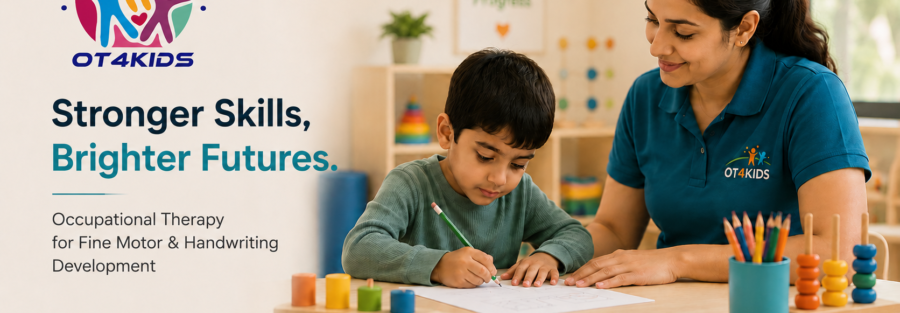
If your child struggles to hold a pencil, write legibly, or manage buttons and zippers, you’re not alone. Fine motor skill difficulties affect many children and can impact academic performance, self-confidence, and daily independence. The good news: occupational therapy (OT) is a proven, evidence-based approach that helps children develop these critical skills.
At OT4KIDS Pediatric Therapy Centre in South Delhi, we’ve spent over 25 years helping children overcome fine motor challenges through individualized, play-based occupational therapy. This guide explains what fine motor skills are, why they matter, how occupational therapy addresses them, and what you can expect from treatment.
What Are Fine Motor Skills and Why Do They Matter?
Fine motor skills involve the coordination of small muscles in the hands, fingers, and wrists. These skills enable children to perform precise, controlled movements necessary for everyday tasks and academic success.
Common fine motor activities include:
- Writing, drawing, and coloring
- Buttoning, zipping, and fastening clothing
- Using utensils to eat
- Picking up small objects (pincer grasp)
- Cutting with scissors
- Tying shoelaces
- Playing with building blocks or puzzles
Fine motor development typically follows a predictable sequence. By age 3, most children can scribble and hold a crayon with a fisted grip. By age 4-5, they develop a more mature pencil grip and can copy simple shapes. By age 6-7, they refine handwriting and can write letters and numbers.
When fine motor development lags, children often experience:
- Difficulty with handwriting legibility and speed
- Frustration during academic tasks
- Avoidance of writing or drawing activities
- Challenges with self-care (dressing, eating independently)
- Reduced participation in play and social activities
- Lower academic performance, especially in early grades
These difficulties can affect not just academics but also a child’s confidence and willingness to engage in learning.
Common Causes of Fine Motor Difficulties
Fine motor challenges can stem from various developmental, neurological, or physical factors:
Developmental Delays: Some children naturally develop fine motor skills at a slower pace. Early intervention through occupational therapy can accelerate progress.
Sensory Processing Issues: Children with sensory sensitivities may avoid certain textures, tools, or activities, limiting practice and skill development. This is particularly common in children with autism spectrum disorder (ASD).
Weak Hand and Finger Strength: Insufficient muscle tone or strength in the hands and forearms prevents sustained control during writing or manipulation tasks.
Poor Hand-Eye Coordination: Difficulty coordinating visual input with hand movements affects precision and control.
Cerebral Palsy and Neurological Conditions: Children with cerebral palsy, Down syndrome, or other neurological conditions often require specialized OT to develop functional fine motor abilities.
ADHD and Attention Difficulties: Children with ADHD may struggle with sustained focus during fine motor tasks, affecting both skill development and performance.
Dysgraphia: A specific learning disability affecting handwriting, often requiring targeted occupational therapy intervention.
Hypermobility or Low Muscle Tone: Excessive joint flexibility or generalized low muscle tone can make precise movements difficult.
Identifying the underlying cause is essential for effective treatment. At OT4KIDS, our occupational therapists conduct comprehensive assessments to understand each child’s unique profile and design targeted interventions.
How Occupational Therapy Addresses Fine Motor Difficulties
Occupational therapy takes a holistic, child-centered approach to fine motor development. Rather than isolated drills, OT uses play-based activities, purposeful tasks, and environmental modifications to build skills naturally.
Assessment and Goal Setting
Our process begins with a thorough evaluation. We assess:
- Current fine motor abilities and limitations
- Sensory processing patterns
- Hand strength, coordination, and control
- Visual-motor integration
- Grasp patterns and pencil grip
- Functional performance in writing, self-care, and play
- Environmental and family factors affecting development
Based on this assessment, we collaborate with parents to set realistic, meaningful goals. Goals might include “write name legibly,” “button shirt independently,” or “complete classroom writing tasks without frustration.”
Play-Based Skill Building
Children learn best through play. Our occupational therapists embed fine motor practice into engaging, age-appropriate activities:
Sensory Play: Activities like playdough, sand, water, and textured materials build hand strength and sensory tolerance while being inherently enjoyable.
Construction and Manipulation: Building with blocks, LEGO, puzzles, and threading activities develop coordination, planning, and bilateral hand use.
Art and Craft Activities: Coloring, painting, cutting, and collage work refine pencil control and hand-eye coordination in a creative context.
Functional Tasks: We practice real-world activities like buttoning, zipping, eating with utensils, and writing in contexts that matter to the child.
Gross Motor Foundation: Fine motor skills build on a foundation of core strength and stability. We often incorporate gross motor activities (balance, coordination) to support fine motor development.
Pencil Grip and Handwriting Intervention
For children struggling with handwriting, we address:
Grip Development: We guide children toward a functional tripod or quadrupod grip through progressive activities, using adaptive pencil grips when needed.
Posture and Positioning: Proper sitting posture, table height, and paper positioning are essential for efficient handwriting. We optimize these factors.
Letter Formation: We teach correct letter formation, starting with large movements and progressing to refined pencil control.
Speed and Fluency: As accuracy improves, we gradually increase writing speed to match classroom demands.
Handwriting Legibility: We focus on consistent letter size, spacing, and alignment—the elements that make writing readable.
Sensory Integration for Fine Motor Success
Many children with fine motor difficulties also have sensory processing challenges. Our occupational therapists integrate sensory strategies:
- Proprioceptive Input: Heavy work activities (pushing, pulling, resistance) calm the nervous system and improve body awareness, supporting better motor control.
- Tactile Desensitization: Gradual exposure to different textures helps children tolerate varied materials and tools.
- Visual-Motor Coordination: Activities that link what the child sees with hand movements improve precision.
This sensory-motor integration is particularly valuable for children with autism, sensory processing disorder, or ADHD.
What to Expect from Occupational Therapy Treatment
Timeline and Progress
Progress varies based on the child’s age, the severity of difficulties, and consistency of practice. Most children show noticeable improvement within 4-8 weeks of regular therapy. Significant functional gains typically emerge over 3-6 months.
Factors affecting timeline:
- Age: Younger children (3-5 years) often progress faster due to greater neuroplasticity.
- Frequency: Consistent weekly sessions produce better results than sporadic attendance.
- Home Practice: Carryover activities practiced at home accelerate progress.
- Underlying Conditions: Children with neurological conditions may progress more gradually but still achieve meaningful gains.
Frequency and Duration
Typical occupational therapy for fine motor difficulties involves:
- 1-2 sessions per week for 30-60 minutes
- Duration: 3-6 months for mild difficulties; 6-12+ months for more significant challenges
- Regular reassessment: Progress is monitored every 4-6 weeks, and goals are adjusted as needed
Our team at OT4KIDS customizes frequency and duration based on each child’s needs and family circumstances.
Home Program and Family Involvement
Occupational therapy is most effective when parents are actively involved. We provide:
- Specific home activities tailored to your child’s goals
- Guidance on environmental setup (desk height, lighting, seating)
- Strategies for encouraging practice without pressure or frustration
- Education about your child’s developmental profile and how to support progress
Parents are partners in therapy, not passive observers. Regular communication ensures consistency between clinic and home.
Red Flags: When to Seek Occupational Therapy
Consider an occupational therapy evaluation if your child:
- By age 2-3: Cannot scribble, struggles with self-feeding, or has difficulty with dressing
- By age 4-5: Cannot hold a crayon with control, avoids fine motor play, or struggles with scissors
- By age 6-7: Has illegible handwriting, writes very slowly, complains of hand fatigue, or avoids writing tasks
- Any age: Shows significant frustration during fine motor activities, avoids play with peers due to skill gaps, or has difficulty with self-care tasks
- Sensory concerns: Avoids certain textures, resists touching messy materials, or has extreme reactions to tactile input
- Coordination issues: Appears clumsy, has difficulty with bilateral coordination (using both hands together), or struggles with visual-motor tasks
Early intervention is powerful. The younger a child receives support, the more quickly skills typically develop.
Why Choose OT4KIDS for Pediatric Occupational Therapy in South Delhi
OT4KIDS brings 25+ years of specialized pediatric therapy experience to South and West Delhi families. Here’s what sets us apart:
Expert Leadership: Dr. Arpan Kumar and our multidisciplinary team combine deep expertise in occupational therapy, speech therapy, special education, behavior modification, and feeding therapy.
Individualized Approach: We reject one-size-fits-all treatment. Every child receives a customized assessment and therapy plan based on their unique profile, strengths, and challenges.
Child-Centered, Play-Based Methods: Our therapy is engaging, joyful, and developmentally appropriate—children progress while having fun.
Comprehensive Multidisciplinary Services: Beyond occupational therapy, our integrated speech therapy, special education, behavior modification, and feeding therapy services address the whole child. This multidisciplinary approach ensures fine motor gains connect to communication, academic, and behavioral progress—delivering transformative outcomes that extend far beyond handwriting.
Family-Centered Care: We partner with parents, provide clear communication, and empower families with strategies and understanding.
Proven Results: Over 25 years, we’ve helped countless children in South and West Delhi achieve real-life independence, confidence, and improved quality of life.
Frequently Asked Questions
Q: At what age should my child start occupational therapy for fine motor difficulties?
A: Children can benefit from occupational therapy as early as age 2-3 if developmental delays are evident. Early intervention is most effective. However, children of any age can benefit from OT. If you notice fine motor challenges, an evaluation is worthwhile regardless of age.
Q: How long does occupational therapy take to show results?
A: Most children show noticeable improvements within 4-8 weeks of consistent therapy. Significant functional gains typically emerge over 3-6 months. Progress depends on the child’s age, the severity of difficulties, therapy frequency, and home practice consistency.
Q: Can occupational therapy help with handwriting if my child has dysgraphia?
A: Yes. Dysgraphia—a specific learning disability affecting handwriting—responds well to occupational therapy. Our therapists address underlying fine motor, sensory, and motor planning difficulties while teaching compensatory strategies and optimizing handwriting efficiency.
Q: Is occupational therapy covered by insurance?
A: Coverage varies by insurance plan and policy. We recommend checking your specific plan or contacting us directly to discuss your child’s needs and insurance eligibility. We can provide guidance on documentation and claims.
Q: What if my child has autism or ADHD? Can occupational therapy still help?
A: Absolutely. Occupational therapy is highly effective for children with autism and ADHD. We integrate sensory strategies, address sensory sensitivities, and use engagement techniques tailored to neurodivergent learners. Many children with autism or ADHD show significant progress in fine motor skills and handwriting with specialized OT.
Q: How can I support my child’s fine motor development at home?
A: We provide specific home activities during therapy. General strategies include: offer varied play materials (playdough, blocks, puzzles), encourage drawing and coloring without pressure, practice self-care tasks (buttoning, zipping), and limit screen time to allow hands-on play. Avoid forcing practice; make it playful and pressure-free.
Q: What’s the difference between occupational therapy and tutoring for handwriting?
A: Tutoring focuses on teaching letter formation and writing mechanics. Occupational therapy addresses the underlying fine motor, sensory, and motor planning foundations that enable efficient handwriting. OT is often necessary when fine motor difficulties are the root cause of handwriting challenges.
Getting Started with OT4KIDS in South Delhi
If your child is struggling with fine motor skills, handwriting, or daily living tasks, occupational therapy can make a real difference. At OT4KIDS Pediatric Therapy Centre in South Delhi, we’re ready to help.
Here’s how to begin:
1. Schedule a Consultation: Contact us to discuss your child’s challenges and goals. We’ll answer your questions and explain our approach.
2. Comprehensive Assessment: Our occupational therapist will conduct a thorough evaluation to understand your child’s unique profile, strengths, and areas for growth.
3. Customized Therapy Plan: Based on assessment findings, we’ll develop an individualized therapy plan with clear, meaningful goals and a realistic timeline.
4. Begin Treatment: Your child will start therapy in our child-friendly, play-based environment. We’ll keep you informed of progress and adjust the plan as needed.
5. Home Support: We’ll provide specific activities and strategies for home practice, ensuring progress extends beyond the clinic.
With over 25 years of experience and a commitment to each child’s independence and confidence, OT4KIDS is your trusted partner in your child’s developmental journey.